Ikat Chevron Seamless Pattern Digital Paper: A Versatile Resource for Designers and Makers
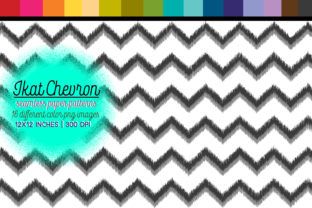
Seamless pattern design has long been a cornerstone of visual communication—whether applied to textiles, packaging, web interfaces, or educational materials. Among the most enduring and adaptable motifs is the ikat chevron seamless pattern digital paper, a fusion of traditional textile artistry and modern digital precision. Unlike static graphics or one-off illustrations, this type of digital paper is engineered for infinite tiling without visible seams, enabling fluid, scalable application across physical and digital media. Its distinctive rhythm—formed by interlocking diagonal bands with subtle, hand-crafted texture—lends warmth and intentionality to otherwise flat surfaces.
What Makes This Collection Distinctive?
This particular offering—a 16-piece digital paper collection in ikat chevron—stands out not only for its aesthetic cohesion but also for its technical execution. Each file is delivered as a high-resolution PNG at 3600 × 3600 pixels, rendered at 300 DPI. That resolution ensures fidelity whether printed on letter-sized stationery or scaled across a 48-inch banner. The square aspect ratio simplifies tiling in design software like Adobe Illustrator, Affinity Designer, or even Canva’s advanced upload settings—no cropping or alignment guesswork required.
Crucially, the 16 variants aren’t arbitrary color shifts. They reflect thoughtful chromatic exploration: muted earth tones (ochre, slate, charcoal), soft pastels (dusty rose, seafoam, oat), and bold primaries (cobalt, crimson, citrine) each retain the same underlying ikat grain and chevron geometry. This consistency means designers can build cohesive palettes across projects—using one shade for a business card background, another for an event program border, and a third for a slide deck accent—without compromising visual harmony.
For Graphic Designers and Brand Strategists
Brand identity systems increasingly rely on pattern-based extensions—not just logos and typography, but tactile, repeatable textures that reinforce personality. An ikat chevron seamless pattern digital paper serves as a flexible “pattern layer” in brand guidelines. For example, a sustainable fashion label might use the charcoal-and-linen variant behind product photography on its website, then apply the terracotta-and-cream version to woven garment tags and packaging inserts. Because all 16 files share identical scale and rhythm, switching between them maintains proportional integrity—no reworking of layout grids or spacing rules.
In Educational and Instructional Materials
Educators developing printable resources—from classroom posters to student workbooks—benefit from patterns that support focus rather than distract. The organic irregularity of ikat dye-resist lines softens the rigidity of chevron geometry, resulting in a motif that feels structured yet approachable. A science teacher might use the sage-and-ivory pattern as a subtle background for lab safety checklists; its low-contrast palette reduces eye strain during prolonged reading while adding visual interest absent in plain white sheets. Similarly, early literacy worksheets gain gentle visual scaffolding when built atop the soft blue-and-sand variant—guiding attention without competing with text.
For Crafters, Print-on-Demand Sellers, and Small-Business Owners
The rise of print-on-demand platforms has amplified demand for production-ready assets. With these files, creators skip time-intensive pattern creation or licensing hurdles. A stationery designer launching a wedding suite can embed the blush-and-ash ikat chevron into envelope liners, save-the-date borders, and digital RSVP cards—all using the same file, ensuring pixel-perfect continuity. Likewise, a small-batch ceramics studio might license the pattern for custom wrapping paper or product labels, confident that the 300 DPI resolution meets commercial printer specifications for spot-color or full-color lithography.
Within Digital Product Development
UI/UX designers occasionally overlook pattern as a tool for interface depth—but subtle, tileable textures enhance perceived polish. While heavy backgrounds are discouraged in responsive web design, a lightly overlaid ikat chevron (at 5–10% opacity) can add dimension to hero section dividers or modal windows. Developers integrating SVG backgrounds may convert the PNGs to CSS background-image declarations with repeat—a lightweight alternative to large image assets. The uniform 3600 × 3600 size also streamlines batch processing via automation tools like ImageMagick or Figma plugins, enabling rapid generation of mockup variations.
Technical Considerations for Optimal Use
Though designed for ease of use, maximizing the value of this ikat chevron seamless pattern digital paper collection involves awareness of a few practical factors:
- File Format Limitation: PNG preserves transparency and sharp edges but doesn’t support vector scaling. For applications requiring infinite scalability (e.g., large-format signage where zooming reveals pixelation), users should confirm final output dimensions before committing—though at 3600 × 3600, even 200% enlargement remains crisp for most print contexts.
- Color Mode Consistency: These files are RGB-native, ideal for screen-based work and many digital printers. For offset printing requiring CMYK conversion, designers should soft-proof within their editing software and adjust saturation or contrast as needed—especially with vibrant hues like magenta or kelly green—to avoid unexpected tonal shifts.
- Tiling Behavior: True seamlessness depends on correct implementation. In Photoshop, use “Edit > Define Pattern” after opening a single file; in Illustrator, drag into the Swatches panel and select “Create Pattern.” Avoid manual duplication or copy-paste tiling, which risks micro-gaps or misalignment.
- Licensing Clarity: As with any digital paper, verify usage rights. This collection permits both personal and commercial projects—including resale of derivative physical goods—but prohibits redistribution of the raw files or claiming authorship of the pattern design itself.
Why Ikat Chevron Resonates Across Cultures and Contexts
Ikat—a resist-dyeing technique originating in Indonesia, India, Japan, and Central Asia—carries layered cultural meaning: patience, craftsmanship, and regional identity. When abstracted into chevron form, it bridges heritage and modernity. Unlike rigid geometric patterns generated algorithmically, ikat chevrons retain slight variations in line weight and edge diffusion—the digital equivalent of hand-tied threads bleeding slightly into adjacent colors. That imperfection isn’t a flaw; it’s a signal of authenticity, making the pattern feel human-made rather than machine-generated.
This resonance explains its cross-sector appeal. A university anthropology department might use the indigo-and-cream variant in exhibition banners to evoke textile traditions without literal reproduction. A wellness app developer could adopt the lavender-and-slate pattern for meditation guide PDFs—its quiet rhythm supporting calm focus. Even data visualization specialists have begun incorporating such patterns as non-intrusive fill textures in bar charts or infographics, where color alone might oversimplify categorical distinctions.
Integrating the Collection Into Existing Workflows
Adoption requires minimal disruption. Designers using cloud-based libraries (Adobe Creative Cloud Libraries, Dropbox Paper, or Notion asset databases) can upload all 16 files as a named set—tagging each with its dominant hue and use-case notes (e.g., “#7B5E57 – Warm Neutral – Business Cards”). For teams, establishing a shared naming convention—such as ikat-chevron-ochre-3600x3600.png—prevents version confusion during collaborative editing.
Hobbyists working in free tools like GIMP or Photopea will find the PNG format universally compatible. No plugin installation is needed—just open, copy, and paste into canvas layers. For educators building Google Slides templates, uploading one file as a background image automatically tiles it across slides; adjusting opacity in the “Format Options” sidebar provides instant customization without altering the source asset.
Importantly, this 16-piece digital paper collection in ikat chevron functions best not as a standalone decoration but as a foundational element—like quality paper stock or calibrated monitor profiles. Its strength lies in enabling consistency, saving time, and quietly elevating execution. Whether used to line a handmade journal, texture a Shopify product page, or add tactility to a conference presentation, it operates beneath conscious notice while contributing to overall perception of care and professionalism.
Looking Ahead: Pattern as Infrastructure
As design ecosystems grow more modular—from design tokens in Figma to component libraries in Webflow—the role of seamless patterns is evolving. They’re no longer just “backgrounds” but reusable infrastructure: visual primitives that communicate tone, hierarchy, and continuity. Collections like this ikat chevron seamless pattern digital paper represent a shift toward intentional, culturally informed, technically robust assets—ones that serve function first, aesthetics second, and longevity always. In an era of fleeting trends, the quiet persistence of ikat—and its thoughtful digital translation—offers something rare: relevance that deepens with use.