Round Circle Pattern
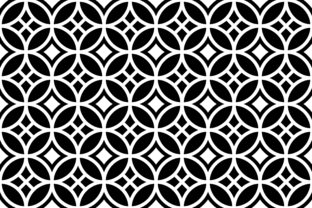
The Round Circle Pattern is a geometric design composed of evenly spaced, identical circles arranged in a grid or tessellated layout. When executed as a seamless vector, it repeats infinitely without visible seams—making it highly versatile for scalable applications. A black-and-white isolated version removes color complexity and background noise, emphasizing contrast, rhythm, and spatial harmony. This minimalist execution supports clarity across print and digital contexts, from textile repeats to architectural wallpaper.
Why Consider a Round Circle Pattern?
Designers, illustrators, and product developers often seek patterns that balance visual neutrality with structural integrity. The Round Circle Pattern meets this need by offering predictable repetition, high scalability, and strong compositional grounding. Its simplicity supports legibility at small scales (e.g., fabric weaves or stationery) and impact at large formats (e.g., wall murals or event banners). Unlike organic or irregular motifs, its mathematical consistency allows precise alignment during printing, cutting, or embroidery—reducing production errors.
Key Benefits
- Scalability: As a vector-based seamless pattern, it retains crisp edges at any size—ideal for both micro-printing on labels and macro-installations on building facades.
- Adaptability: Works equally well on woven textiles, coated paper, vinyl banners, and digital displays due to its low-information density and high-contrast black-and-white formulation.
- Production efficiency: Minimal ink coverage (especially in monochrome variants) lowers material costs and shortens drying times in screen or rotary printing.
- Design flexibility: Serves as a neutral base layer—easily overlaid with typography, illustrations, or photographic elements without competing visually.
Tradeoffs and Practical Considerations
While the Round Circle Pattern offers predictability, its uniformity can limit expressive range. Because all elements are identical and regularly spaced, it may lack visual hierarchy or focal points unless intentionally modified (e.g., through variable sizing, opacity shifts, or selective cropping). Users should also verify tiling behavior: not all “seamless” vectors perform identically across software—some require manual alignment in Adobe Illustrator or Affinity Designer before export to RIP (raster image processor) workflows.
For textile applications, consider fabric drape and weave structure. Tight-knit synthetics reproduce fine circle outlines more faithfully than loose-weave cottons, where halftone effects or slight blurring may occur. Similarly, uncoated paper absorbs ink differently than glossy stock, potentially softening edge definition—so test prints are advisable before full runs.
When It’s a Strong Fit
A Round Circle Pattern excels in scenarios demanding consistency, neutrality, and functional clarity. It is especially appropriate for:
- Branded stationery and packaging: Provides subtle texture without distracting from logos or copy; works well for business cards, letterheads, and gift wrap.
- Architectural surfaces: Wallpaper or wall decals benefit from its even rhythm, helping unify large spaces without overwhelming occupants.
- Technical illustration backgrounds: Engineers or educators use it to add depth behind diagrams while preserving readability—unlike busy floral or abstract patterns.
- Repeat-based manufacturing: Screen-printed fabrics, laser-cut paper goods, or CNC-etched panels rely on repeat accuracy, which this pattern delivers reliably.
When Alternatives May Be Worth Exploring
Not every project benefits from strict circular repetition. Consider alternatives if:
- You require directional emphasis—e.g., for wayfinding signage or banner layouts where vertical or horizontal flow improves scanning. In such cases, linear stripe or wave patterns may support better visual guidance.
- Your audience responds to warmth or tactility. Hand-drawn dots, watercolor blobs, or offset-printed halftones introduce variation and human imperfection that a mathematically perfect Round Circle Pattern does not offer.
- You’re working within strict brand guidelines that prohibit symmetry or mandate asymmetry—for example, in avant-garde fashion or experimental publishing. Here, irregular scatter patterns or randomized dot matrices provide greater expressive latitude.
- Scale constraints limit resolution. Very small applications (e.g., embroidery on thin silk) may render individual circles indistinct; a simplified grid or single-dot motif could improve legibility.
Making an Informed Decision
Evaluating whether a Round Circle Pattern suits your needs begins with clarifying intent. Ask yourself:
- Is visual neutrality more important than emotional resonance?
- Does the application involve repeated physical output (e.g., fabric rolls, wallpaper bolts), where seamlessness directly affects usability?
- Will end users interact with the pattern up close (e.g., apparel worn daily) or at a distance (e.g., trade show backdrops)?
- Do existing assets—logos, photography, typography—contain curves or circles already? Harmonizing with those elements may reinforce cohesion.
If most answers point toward functionality, scalability, and cross-medium consistency, the Round Circle Pattern is likely aligned with your goals. If instead you prioritize narrative, texture, or brand personality over precision, explore variations like concentric circles, dotted gradients, or staggered arrangements—still rooted in circular geometry but less rigid in execution.
Final Notes on Implementation
When sourcing or creating a Round Circle Pattern, confirm it is truly seamless—not merely tiled—and delivered in editable vector format (e.g., .ai or .svg). Avoid raster-based versions unless resolution requirements are fixed and modest. For textile use, request a tile dimension that matches standard fabric repeat measurements (e.g., 24" × 24" or 50 cm × 50 cm). And always preview the pattern in context: place it beneath sample text, overlay it with representative imagery, or simulate it on a mockup of your intended surface. Doing so reveals how the Round Circle Pattern behaves—not just as a standalone asset, but as part of a larger system of communication and experience.