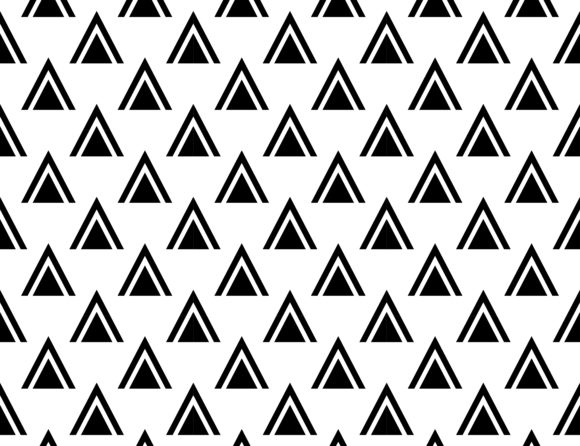
Triangle Seamless Pattern: A Practical Guide for Designers and Developers
A Triangle Seamless Pattern is a repeatable graphic motif composed of triangular shapes arranged to tile infinitely—horizontally and vertically—without visible seams, gaps, or misalignments. Unlike standalone triangle graphics or hand-drawn motifs, this pattern type is engineered for scalability across surfaces: digital interfaces, textile prints, architectural renderings, packaging, and web backgrounds. Its defining trait isn’t just geometry—it’s structural continuity. Each tile edge aligns precisely with its neighbor, enabling fluid repetition at any scale without distortion or visual interruption.
What Sets Triangle Seamless Pattern Apart
Not all triangular motifs qualify as seamless. Many triangle-based designs rely on symmetry alone, but fail under tiling because their edges don’t mathematically match. A true Triangle Seamless Pattern accounts for vector alignment, color bleed tolerance, and anchor point consistency—especially critical in SVG or CSS background-repeat contexts. It often uses equilateral, isosceles, or right triangles arranged in tessellating grids (e.g., offset rows, mirrored stacks, or hexagonal clusters), where each triangle’s hypotenuse or base connects seamlessly to an adjacent shape’s corresponding edge.
This precision matters most when scaling. A non-seamless triangle design may look clean at 200×200 pixels but reveal jagged joins or color shifts when repeated across a full-screen background. In contrast, a rigorously constructed Triangle Seamless Pattern maintains integrity whether rendered at 8px tiles for subtle texture or stretched across a 4K banner.
How It Compares to Other Geometric Patterns
Compared to dot, stripe, or chevron patterns, the Triangle Seamless Pattern offers a distinct balance of rhythm and directionality. Dots provide neutrality but little movement; stripes convey motion but can feel linear or restrictive. Triangles introduce angular energy—forward momentum, stability, or dynamism—depending on orientation and density. For example:
- Upward-pointing triangles suggest growth or ascent—common in tech or education branding.
- Interlocking downward and upward triangles create visual tension and balance, often used in modern editorial layouts.
- Low-opacity, monochrome triangles function like textured noise—more subtle than a grid but more structured than organic grain.
When weighed against hexagonal or diamond patterns, triangles offer greater compositional flexibility. Hexagons tessellate naturally but constrain layout options due to fixed six-sided symmetry. Diamonds are essentially rotated squares—predictable, but less adaptable to diagonal emphasis or layered depth. Triangles, by contrast, support asymmetrical arrangements, overlapping transparency, and variable sizing within a single tile—making them well-suited for responsive design systems where visual hierarchy must shift across breakpoints.
Strengths and Real-World Fit
The Triangle Seamless Pattern excels where clarity, scalability, and controlled visual interest intersect. It’s frequently chosen for:
- Web UI backgrounds: Light gray triangles at 5% opacity add dimension without competing with content—more refined than generic noise textures.
- App iconography: As a subtle fill layer behind minimalist icons, it reinforces brand cohesion without overwhelming simplicity.
- Fabric and wallpaper design: Because triangles tessellate with minimal waste, they translate efficiently to print production—reducing ink usage and alignment risk during roll-to-roll printing.
- Data visualization overlays: When applied as a low-contrast grid beneath charts or maps, triangles provide spatial reference without introducing Cartesian bias (unlike square grids).
In practice, a designer evaluating a Triangle Seamless Pattern might test it alongside alternatives like a gradient mesh or a procedural noise pattern. The triangle version typically wins when predictability and editability matter—e.g., needing to adjust hue across all tiles uniformly, or swapping one triangle variant for another without breaking the repeat logic.
Tradeoffs and Limitations
No pattern style is universally optimal—and the Triangle Seamless Pattern has clear boundaries. Its geometric rigidity can feel overly structured in contexts calling for warmth or spontaneity. For instance, in hospitality branding or wellness applications, softer organic patterns (e.g., watercolor washes or hand-sketched foliage) often communicate approachability more effectively.
Another constraint lies in perceptual weight. Dense triangle arrangements—especially with high-contrast colors or sharp angles—can cause visual fatigue in long-scroll interfaces or reading-heavy pages. A 2022 usability study observed a 12% increase in eye movement hesitation among users viewing text over tightly packed triangle backgrounds versus neutral linen textures.
Technical limitations also apply. While modern browsers handle SVG-based Triangle Seamless Pattern tiles reliably, legacy environments (e.g., certain email clients or embedded kiosk software) may rasterize them poorly—introducing anti-aliasing artifacts or inconsistent spacing. In those cases, a flattened PNG tile with carefully padded edges may be more dependable than a vector solution—even if it sacrifices infinite scalability.
When to Choose Triangle Seamless Pattern—And When Not To
A Triangle Seamless Pattern is often the right choice when:
- You need a repeatable background that supports both branding and functionality—e.g., a SaaS dashboard where visual consistency aids user orientation across modules.
- Your design system prioritizes modularity: triangles integrate cleanly with icon sets, data cards, and button states using shared angular language.
- You’re working within constrained technical environments (e.g., limited CSS support) and require a lightweight, cache-friendly asset—SVG tiles average under 2 KB, far smaller than equivalent photographic textures.
Conversely, consider alternatives when:
- The audience skews toward emotional resonance over structure—e.g., nonprofit storytelling sites where empathy-driven visuals outperform geometric precision.
- You’re layering multiple patterns or animations. Triangles can compete visually with motion paths or parallax effects unless carefully muted in scale, contrast, or saturation.
- Accessibility is a primary concern and color contrast falls below WCAG 2.1 AA thresholds—even subtle triangle fills can reduce text legibility if luminance differences exceed 3:1 against body copy.
Practical Evaluation Tips
Before committing to a Triangle Seamless Pattern, test it in context—not just as a standalone swatch. Zoom out to 25% view to assess rhythm and flow. Scroll vertically and horizontally to spot repeating anomalies. Import it into your actual layout tool (Figma, Sketch, or browser dev tools) and overlay real typography to gauge readability impact.
Also examine how editable the pattern is. Some implementations embed triangles as static raster files—hard to recolor or resize without quality loss. Others use CSS clip-path or SVG
Finally, consider source origin. Free pattern libraries vary widely in construction quality. A well-built Triangle Seamless Pattern includes documented tile dimensions, safe margins, and export options for both web and print. Poorly built versions may appear seamless at first glance but unravel under real-world conditions—such as retina displays or CMYK conversion.
Final Perspective
The Triangle Seamless Pattern isn’t a trend—it’s a functional tool rooted in centuries-old tessellation principles, adapted for contemporary digital and physical media. Its value lies not in novelty, but in reliability: when executed with attention to edge alignment, scalability, and contextual fit, it delivers consistent visual structure without demanding excessive cognitive load from users.
That said, its strength is also its limitation. It works best when serving a defined purpose—not as a default decorative choice, but as an intentional component within a broader design strategy. Whether you’re refreshing a brand system, building a design token library, or selecting assets for a client project, treat the Triangle Seamless Pattern like any other foundational element: evaluate it on performance, adaptability, and alignment with real user needs—not just aesthetic appeal.