What Is a Seamless Flamingo Pattern? A Practical Guide for Designers and Creatives
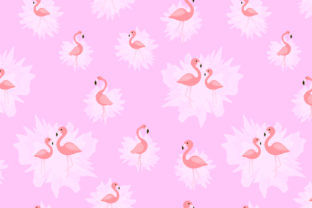
A seamless flamingo pattern is a repeating digital or print design featuring stylized flamingos—often in elegant poses, soft pastel tones, or playful arrangements—that tiles perfectly without visible edges or breaks. Unlike standalone flamingo illustrations, a seamless version is engineered so that when copied and repeated horizontally and vertically, the motif flows continuously across any surface: from wallpaper and fabric to website backgrounds and mobile app interfaces.
Why “Seamless” Matters More Than You Think
The word seamless isn’t just marketing flair—it’s a technical requirement rooted in graphic design fundamentals. A truly seamless pattern aligns its left and right edges *and* its top and bottom edges so precisely that no seam, gap, or misaligned element is visible upon tiling. This precision ensures visual harmony at any scale, whether printed on a 10-foot mural or rendered as a tiny CSS background on a smartphone screen.
Without seamless construction, repeating a flamingo motif creates distracting “jumps”—a leg cutting off abruptly at the right edge, or feathers vanishing mid-stroke at the top. These inconsistencies break immersion and undermine professionalism, especially in branding, interior design, or product packaging where consistency signals quality and care.
How Seamless Flamingo Patterns Are Created
Designing a seamless flamingo pattern involves both artistic vision and technical discipline. Here’s how professionals typically approach it:
- Start with a tileable canvas: Most designers use a square artboard (e.g., 2000×2000 pixels) in tools like Adobe Illustrator or Procreate. The dimensions don’t need to be huge—but they must be consistent and divisible for precise alignment.
- Build elements across boundaries: Key flamingo features—like wings, neck curves, or legs—are intentionally extended beyond the canvas edges. Later, these “bleed” areas are mirrored or offset to match adjacent tiles.
- Use built-in tiling tools: Software such as Illustrator’s Pattern Maker or Affinity Designer’s Repeat Tool automates edge-matching, but human review remains essential to catch subtle misalignments in feather texture or shadow placement.
- Test rigorously: Designers tile the pattern across a large grid (e.g., 5×5 repeats) and zoom out to spot seams. They also preview it on mockups—fabric swatches, phone screens, or wall panels—to assess real-world impact.
This process blends creativity with constraint—a reminder that great design often thrives within technical boundaries.
Where You’ll Encounter Seamless Flamingo Patterns Today
Far from being niche or novelty-only, seamless flamingo patterns appear across diverse contexts—each leveraging their visual appeal and functional reliability:
Interior Design & Home Decor
From tropical-themed nurseries to boutique hotel lobbies, seamless flamingo wallpaper adds personality without visual clutter. Because the pattern repeats flawlessly, installers avoid awkward cut lines near windows or ceilings—reducing waste and labor time. Similarly, seamless flamingo-printed curtains, cushions, and shower curtains maintain elegance whether hung solo or layered with complementary solids.
Fashion & Textile Printing
Apparel brands use seamless flamingo motifs for summer dresses, swimwear linings, and scarves. Digital textile printers rely on seamless files to ensure continuous prints across yards of fabric—no matter the garment’s size or shape. A non-seamless file would cause visible repeats at seam allowances, compromising wearability and brand perception.
Digital Interfaces & Branding
Websites, presentation decks, and social media templates increasingly feature subtle seamless flamingo backgrounds—not as loud statements, but as tonal accents reinforcing themes of balance, grace, or joyful sophistication. When optimized as lightweight SVG or CSS-repeating PNGs, these patterns enhance user experience without slowing load times.
Common Misconceptions—Debunked
Despite growing popularity, several assumptions about seamless flamingo patterns persist—and often lead to poor implementation:
- “Any flamingo image can become seamless with a filter.” False. Automatic “seamless” filters rarely handle organic shapes like curved necks or overlapping feathers accurately. Manual refinement is almost always required for professional results.
- “More flamingos = better pattern.” Not necessarily. Overcrowding reduces breathability and makes scaling difficult. Top-tier seamless patterns often use negative space strategically—letting a single flamingo anchor the repeat while supporting elements (palms, water ripples, or abstract gradients) provide rhythm.
- “Seamless means ‘generic’ or ‘trendy-only.’” Quite the opposite. Many artists craft bespoke seamless flamingo patterns reflecting cultural motifs (e.g., Art Deco silhouettes, Japanese ukiyo-e influences, or Afro-Caribbean color palettes), transforming them into meaningful storytelling tools—not just decor.
Choosing the Right Seamless Flamingo Pattern for Your Project
Not all seamless flamingo patterns serve the same purpose. Consider these practical criteria before selecting or commissioning one:
- Scale & density: A large-scale flamingo repeat works well on walls or tote bags; a micro-repeat suits business cards or email headers.
- Color mode: CMYK-optimized files are essential for print; RGB + sRGB profiles suit web use. Always confirm compatibility with your output medium.
- Licensing clarity: Free downloads may lack commercial rights. Reputable marketplaces like Creative Market or Adobe Stock specify usage terms—especially important for logos, merchandise, or client work.
- Customization potential: Vector-based (SVG/EPS) patterns allow easy recoloring and resizing; raster files (PNG/JPEG) require more effort to adapt.
When in doubt, request a test tile—even a small 2×2 grid reveals alignment issues faster than scrolling through a full preview.
Why This Pattern Endures Beyond Trends
Flamingos carry rich symbolic weight across cultures: resilience (thriving in alkaline lakes), partnership (they mate for life), and adaptability (migrating across continents). A well-designed seamless flamingo pattern doesn’t just look pleasing—it quietly communicates those values. In workplaces, it softens sterile environments. In education materials, it engages young learners without overwhelming them. In wellness apps, its gentle curves and warm hues support calm focus.
Moreover, the rise of biophilic design—integrating nature-inspired elements into human spaces—has renewed interest in animal-based motifs that feel authentic, not cartoonish. Seamless flamingo patterns, especially those grounded in observational accuracy (feather layering, anatomical proportion, natural lighting), align perfectly with this movement.
Getting Started—Your Next Step
Whether you’re a DIY decorator, a freelance designer, or a small-business owner refreshing your brand aesthetic, exploring seamless flamingo patterns is simpler than ever. Begin by browsing curated collections on trusted platforms like Creative Market or Adobe Stock, filtering for “seamless,” “vector,” and “commercial use.” Download samples, test them in your preferred software, and observe how they behave at different scales.
For deeper learning, consider short courses on pattern design fundamentals—many cover flamingo-specific workflows, including how to stylize anatomy for repetition without losing recognizability. And if you’re commissioning custom work, share reference images, intended applications, and brand guidelines upfront. Clarity here saves revisions—and strengthens the final result.
Ultimately, a seamless flamingo pattern is more than decoration. It’s a fusion of biology and geometry, artistry and algorithm, playfulness and precision. When chosen thoughtfully and applied intentionally, it doesn’t just fill space—it invites connection, evokes emotion, and endures long after the “tropical trend” has cycled out of headlines.